
Fruits and vegetables are both essential components of a healthy diet. Fruits are rich in vitamins and minerals and they require a shorter digestion time than do vegetables, as the principle sugar in fruit is fructose which requires no further digestion. Vegetables, on the other hand consist mainly of complex carbohydrates, and also have a different ratio of soluble to non-soluble fibres.
Because of the differences in composition, fruits and vegetables have different digestion and
stomach retention times and the eating of fruits and vegetables at the same meal can lead to fermentation in the stomach. Symptoms produced by incorrect combinations include flatulence, halitosis and all the conditions associated with an acid system. Vegetables take on average two hours longer to digest than fruits, and it has been suggested that fruits be only eaten by themselves, however, the consensus of opinion is that fruits and vegetables combine well with grains, nuts and legumes but do not combine well with each other. The digestion of the protein component in grains, nuts and legumes in the stomach takes place rapidly and provided that the system is not subjected to free fats, animal proteins, or excessive quantities of high-protein foods, this digestion takes place rapidly enough to prevent fermentation. It is therefore not necessary to eat fruits only by themselves, and a breakfast consisting of grains and fruits is therefore not only compatible, but advisable, particularly for young children who need high energy foods to start the day.
Another issue that can be confusing is the question as to what should be regarded as a fruit and what should be regarded as a vegetable. Biologically the products of a blossom containing seed must be considered fruits, however, in terms of their composition and also their common usage, some biological fruits are more like vegetables in that their principle carbohydrate is not fructose but complex carbohydrates. To confuse the issue even further, some fruits and vegetables are neutral and produce no adverse effects when combined with either fruits or vegetables at the same meal. The neutral vegetables are mainly the high-water content vegetables with very low starch content and the neutral fruits are largely the high fat content fruits such as avocados and olives. In table 7.4 a list of likely compatible and non-compatible combinations is presented. It must be noted, however, that this list is not iron clad as no hard and fast rule exists in this regard, and what works well for one individual may cause discomfort for another. Nevertheless, it is intended to provide a starting point for the selection of compatible combinations.
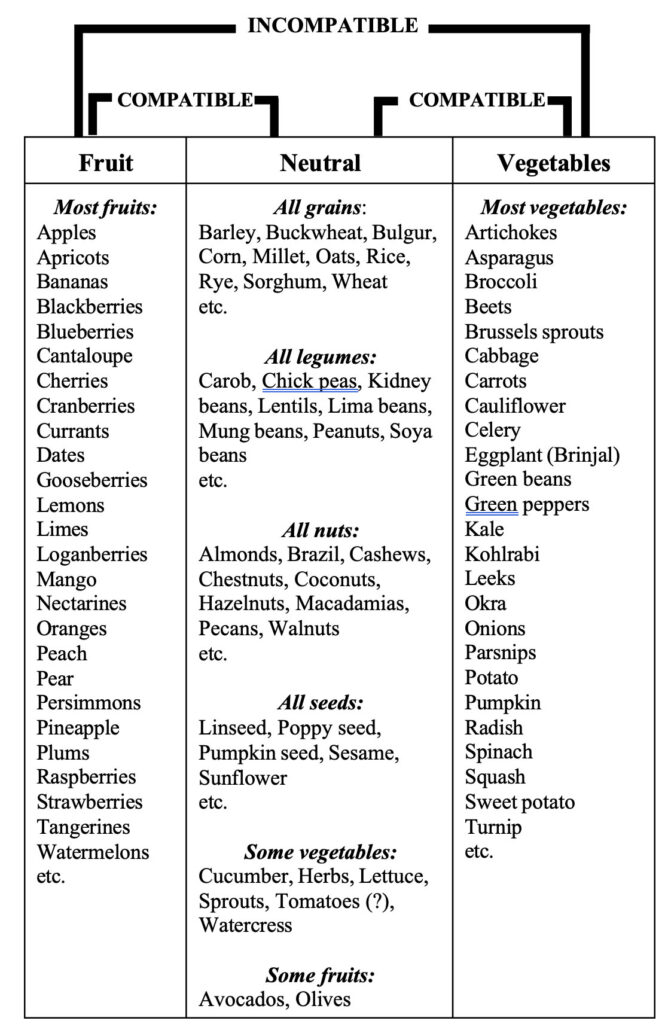
Table 7.4. Compatible combinations of plant foods.
It is important to vary the diet. Variation must be the watchword for healthful living. Some foods contain components which will suppress the uptake of vitamins and minerals in other foods, so that even if all the elements required by the system should be present in one meal, not all of them may be maximally utilized in that particular combination. By varying the
combinations, however, we not only make life more interesting, but we