
Foodborne illness is on the increase worldwide and in most cases animal products are implicated as the main source of infection. These infections may be mild, seriously debilitating, and can even be fatal, particularly in elderly people and infants. The contamination of the food is due to micro-organisms or their toxins, and is characterized by diarrhoea, vomiting or both, but can also involve other parts of the body as in the case of listeriosis (caused by Listeria) or botulism which is caused by toxins produced by the bacterium Clostridium botulism. In the case of the latter, as little as 0,1g of food in which this bacterium has grown can be seriously debilitating, and in as many as 20% of cases botulism results in death. Most of the data pertaining to foodborne diseases is from the industrialized nations, but it must be borne in mind that the situation in poorer nations is probably worse.
The bacteria most often implicated with foodborne diseases are Salmonella, Campylobacter, Listeria, Eschericia, Staphylococcus and Yersinia.
Salmonella infections
Animals are the main source of this infection, but the infection can be spread from person to person. In the United States it is estimated that salmonellosis cases range from 790 000 to 3 690 000 per year, with as many as 7 041 deaths resulting from the illness.64 In the last two decades there has been a steady increase in the number of reported cases, and in industrialised countries a dramatic increase seems to have occurred since the mid 1980’s. In both the United States and Canada there has been a steady increase in salmonellosis and between 1975 and 1988 the incidence of notifiable diseases had more than doubled in these countries. Most outbreaks of the disease are associated with animal products such as eggs, cheese and improperly pasteurized milk. Between 1985 and 1989 there was also a steady increase in cases of Salmonella enteritidis in New England and the Mid-Atlantic states where there were 140 outbreaks (4 976 cases and 30 deaths) during this period in which eggs were associated with 65 of these outbreaks.65
Salmonella outbreaks in the UK have also been associated with infections in cattle and poultry, and increases in salmonellosis, since 1985 have been largely linked to a massive rise in cases caused by S. enteritidis attributed largely to poultry and hens’ eggs (figure 4.12).66 The eggs do not only become infected because of cracks in the shell, but they become contaminated because the ovarian tissue of the fowls is infected.
Prevention of contamination requires the co-operation of a wide variety of people from the breeders, veterinarians, epidemiologists, microbiologists and caterers, to every household cook. In view of this complexity it is difficult to control the spread of these diseases, particularly since transport and slaughter of animals increases the number of animals which carry Salmonella. In the UK the proportion of infected calves increases from 0,5% for calves leaving the farm to 36% after slaughter, whereas a US study found that in the case of pigs 7% are infected when they leave the farm, but 50% are infected after slaughter.66
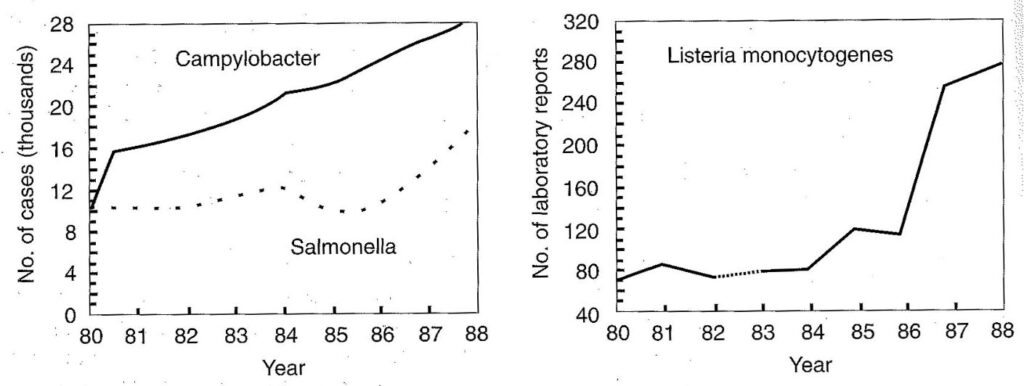
Figure 4.12. Cases of gastrointestinal infection due to bacterial contamination of food. (Adapted from reference 67)
Campylobacter infections
Campylobacteriosis is a common cause of sporadic disease associated mainly with poultry and milk. In Canada this micro-organism is responsible for more cases of infectious diarrhoea than is Salmonella, and in England and Wales it is the most common cause of this illness, with as many as 30 000 cases reported annually.67 Figure 4.12 shows that the incidence of this infection in the UK has also increased dramatically since 1980. In third world countries however the situation is much worse, and in African populations campylobacteriosis is very common.
Listeria infections
Listeria infections are not nearly as common as those caused by Salmonella or Campylobacter, but in view of the serious nature of the symptoms caused by these infections, it is imperative that this organism be strictly controlled. Listeria causes a range of symptoms ranging from mild flu to chronic septicaemia. It can result in abortion, stillbirth or the birth of severely affected babies.67 Listeriosis is caused by eating contaminated food, and in Canada it has claimed more lives than any other food-borne bacteria. The bacteria have been isolated from a wide range of dairy products such as milk, even pasteurized milk, chicken, and sea foods including fish. The bacteria have also been found in coleslaw and even black pepper. Bacterial contamination is also not uncommon in frozen and even pre-cooked chilled chicken.68 In Spain, Listeria spp. Were isolated from milk tanks on farms, and Listeria monocytogenes and L. Innocua were detected in 2.56 and 1.73% of the samples. Moreover, milk contamination by Listeria appeared to be seasonal, with a higher incidence in autumn and winter than in spring or summer and interestingly, the incidence was also lower on mountain farms than in plateau farms.69 Soft cheeses and pates are sometimes heavily infected and there has been a striking increase in disease cases in England and Wales since the mid-1980s (Figure 4.12) and also in North America where it was linked to “Mexican style” soft cheese. Outbreaks also occurred in Switzerland with more than 200 cases reported, and 91 deaths.66 In South Africa there was an outbreak of listeriosis in Soweto which claimed the lives of 43% of the fourteen detected cases. In Soweto alone, between two and four cases of this disease are reported annually. Listeria is particularly troublesome because it can continue to grow at refrigeration temperature.
Eschericia coli infections
Some strains of E. coli can cause intestinal infections. In the US cases of haemorrhagic colitis, haemolytic uraemic syndrome, and thrombotic thrombocytopenic purpura have been reported since 1982. Animal products are again implicated in these infections, and milk and beef are the main sources of infection.70 In May 1996, an epidemic of food poisoning rocked Japan, which the World Health Organization declared “unprecedented” in modern history. The outbreak started in Oku, a fishing village 180 km west of Osaka and spread to virtually every prefecture in Japan and effected more than 8000 people. The elderly and small children suffered most, and numerous deaths were reported. The infectious agent proved to be a particularly virulent strain (0157:H7) of E.Coli. In this case, animal products were once again implicated. Since 1992 enterohaemorrhagic E.coli have become the most frequent causative agent of haemorrhagic diarrhea in North America, and in Europe infections are also becoming more frequent. Unlike other E. Coli, enterohaemorrhagic E.coli possess cytotoxic shiga-toxins which previously were known only in cases of Shigella dysenteriae infections.71
Yersinia infections
Milk and other animal foods are a source of Yersinia enterocolitica which can cause acute gastroenteritis. In Belgium, Canada, the Netherlands, Australia and parts of Germany, infections from this organism are as common as Salmonella infections, and children in particular are vulnerable. The organism can grow at temperatures as low as 0°C and the increase in refrigeration practices may select for this organism.67
Other organisms
Staphylococcus aureus is becoming a frequent pathogen in hospital epidemics, and this is
particularly alarming, since there are a limited number of drugs to which this bacterium is susceptible. It is feared that antibiotic strains of this species could lead to widespread hospital epidemics, should such strains become more common.72 Other infectious micro-organisms that are transmitted by animal products include Clostridium perfringens which is found in meat. From 1986 to 1988 there has been a 46% reported increase of infected cases in the UK A further organism is Vibrio vulnificus which occurs in oysters and has been implicated in infections in the U.S.A.67