
The consumption of caffeine begins at an early age for many people. Caffeine is a natural ingredient in tea, coffee and some soft drinks, and it is used as an additive in many baked goods, frozen dairy products, sweets, gelatins, puddings and soft drinks. The quantities of caffeine in some commonly used items are summarized in table 6.5.
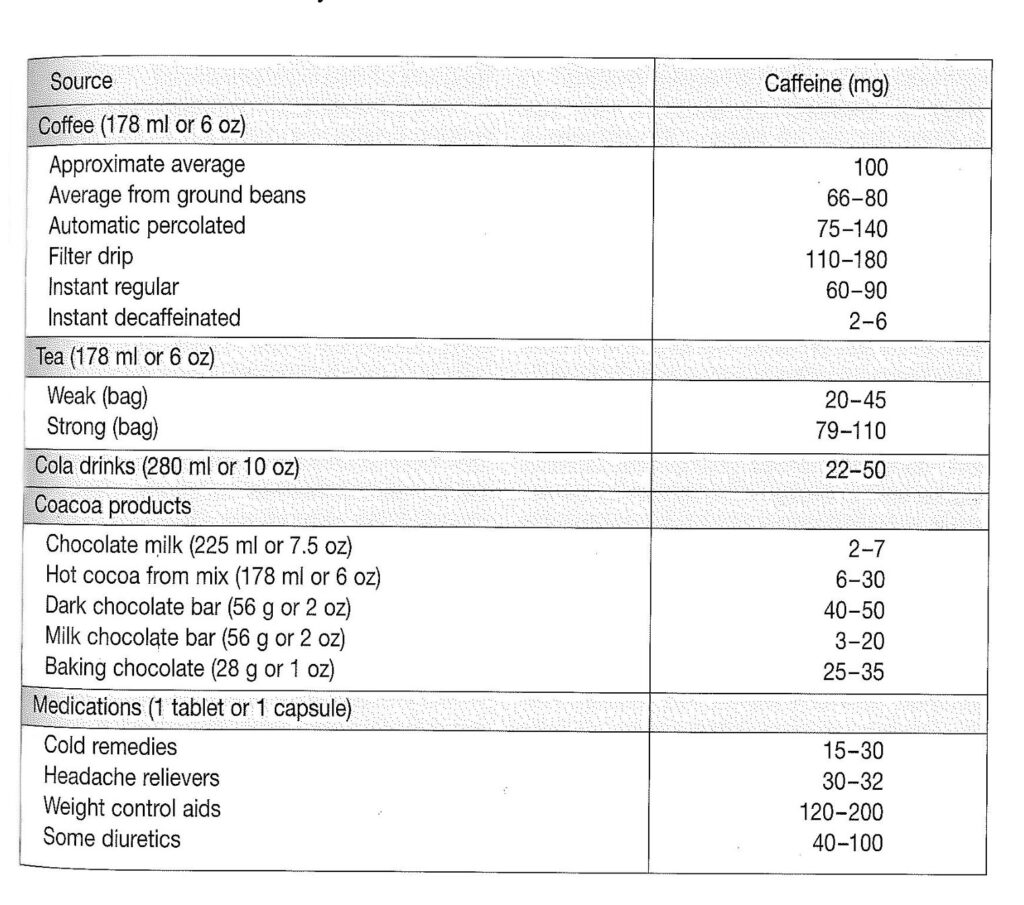
Table 6.5. Sources of caffeine. (From reference 48).
Based on these values the National Institute of Nutrition in Canada estimated that the average daily caffeine consumption of Canadians approximates 450mg per day. Children also consume large quantities of caffeine in the soft drinks and sweets which they consume, and this is a matter of some concern. Adults absorb 99% of the caffeine they consume, and peak blood levels are reached within 15-45 minutes, and the half-life of the caffeine (the time it takes to eliminate 50% of the caffeine from the system) varies from 3-7.5 hours. Caffeine is found in breast milk, and can cross the placenta and thus influence the unborn child. In newborn infants the rate of elimination of caffeine is much slower than in adults, and the half-life is 82 hours. In pre-term infants the half-life ranges from 62-102 hours.48 Some races also experience slower clearance rates than others, and Orientals have a much slower rate of elimination than Europeans. Pregnancy and the use of oral contraceptives also substantially increase the clearance rate.
The Federation of American Societies for Experimental Biology (FASEB) reported the mean consumption of caffeine to be 0.17 mg/kg per day for babies 0-11 months old, 0.49 mg/kg/day for age group 1-5 years, 0.31 mg/kg/day in the 6-11 year age group, 0.21 mg/kg/day in the 12-17 year age group and 0.18 mg/kg/day in the 18 year and older age group. In people with high consumption levels of soft drinks, levels can be significantly higher, and for children in the 1-5 year age group levels can reach 1.8mg/kg/day.49 In view of concerns about the safety of caffeine, and the relatively high concentrations to which children are exposed, the FDA has reviewed the use of caffeine as additives in soft drinks.
The effects of excessive caffeine intake, which in some individuals may be manifested at levels as low as 500 mg/day, include insomnia, headache, anxiety, irritability, and depression. When consumed on an empty stomach it can produce tremors, and at consumption rates of 1g (which is not unusual for some people) can produce symptoms such as fever, agitation, trembling, rapid breathing and heart rate, cardiac palpitations, diuresis, nausea and anorexia. Still higher intakes (5-100g or 50-100 cups of coffee) have caused tachycardia, convulsions, respiratory and heart failure and coma and death due to shock.48 People who stop drinking beverages containing caffeine may experience equally unpleasant withdrawal symptoms, the most common of which are muscle tension, nervousness, irritability and headaches. Caffeine also effects urinary calcium excretion, particularly in postmenopausal women.49 Rats fed instant coffee for 3 to 4 weeks also showed increased calcium loss via the urine and faeces.50 In one study carried out on a group of women (age 50-84), it was found that the consumption of more than two units of caffeinated beverages (one unit = one cup of coffee or two cups of tea), increased the risk of hip fracture by 69%.51 Metabolic studies have shown that the kidneys and intestinal system are directly affected by caffeine..
Of even greater concern than these immediate symptoms are the long-term dangers associated with caffeine, which can occur at lower levels and may be more subtle and difficult to detect. In studies on animals, caffeine was shown to affect the nervous system and influence such behaviours as learning, memory, motor performance, sensory function and emotional reactivity.52,53 These findings have prompted the FASEB to voice their concerns about behavioural effects of caffeine, and effects on the development of the nervous system in children who consume large amounts of cola-type beverages.
The administration of caffeine to pregnant mice indicates that caffeine has toxic effects on the unborn offspring and can possibly produce birth defects. Some of the birth defects noted after the administration of caffeine were: cleft palate, digital defects, muscular disorders, facial deformities, anophthalmia (absence of eyes) and exencephaly (the brain lying outside the skull). In rats the situation is similar, and incomplete ossification in the offspring was also reported.
As these studies suffered from lack of certain controls and low sample numbers the FDA undertook two new studies to resolve the issue of the teratogenic effects of caffeine. These studies revealed that high doses result in death and resorption of embryos, significant reductions in foetal weight, and skeletal abnormalities such as reduced pubis size, reduced dorsal arch and missing hind digits. In fact irreversible birth defects were noted at levels as low as 80 mg/kg and other defects at levels as low as 6 mg/kg.52 Much uncertainty still exists as to whether caffeine increases the risk of birth defects in humans, and it is premature to make such claims. Nevertheless, the stu