
The issue of a rise in infertility, particularly male infertility, has produced considerable controversy in scientific circles. More and more reviews have appeared in the scientific literature claiming a decline in semen quality which is being largely attributed to environmental factors such as exposure to oestrogens (dietary, pharmaceutical and environmental pollutants). It has been suggested that environmental factors, possibly acting in fetal and early neonatal life, may be responsible for the negative effects. Some researchers have claimed that the statistical methodology employed to determine the decline in semen quality was incorrect and that no real decline had taken place over the last decades. To investigate this claim, a group of researchers from the University Department of Growth and Reproduction and the Statistical Research Unit in Copenhagen Denmark, systematically
reviewed the complete international literature on semen analysis since the 1930’s using rigorous selection criteria and statistical analyses. They found, that linear regression of data weighted by the number of men in each study showed a significant decrease in mean sperm count from 113 X106/ml in 1940 to 66 X 106/ml in 1990 (p≤ 0.0001) and in seminal volume from 3.40 ml to 2.75 ml (p=0.027), indicating an even more pronounced decrease in sperm production than expressed by the decline in sperm density. They concluded, that there had been a genuine decline in semen quality over the last 50 years.48
The Danish study was subsequently also criticised with regard to the statistical methodology employed,49 but the issue would still not come to rest. A group of researchers from the MRC Centre for Reproductive Biology in Edinburgh, on the strength of the arguments against the statistical methodologies employed, regrouped the data to account for the year of the donor’s birth and found a similar decline in sperm concentration as reported by the Danish researchers,50 and all the trends seem to point to a decline in the health of the male reproductive system.51 It is true that a number of investigations, particularly with regard to the United States, have not shown a decline in semen quality,52,53,54 but overall the evidence is overwhelming that reproductive health is on the decline. An analysis of semen quality among fertile men in Paris using sperm stored in the sperm bank, showed that between 1973 and 1992 there had been no decline in semen volume, but that sperm concentration, motility and the percentage of morphologically normal spermatozoa had declined significantly.55
Of interest is also an observation that some nations experienced a greater decline than others in terms of semen quality a notable example being the comparison between Finland and Britain, where it has been reported that the British men are less fertile than those from Finland.56 Even in Finland, it has however been reported by researchers from the Forensic Department of the University of Helsinki, that the findings from post mortem analyses of two groups of men from 1981 and 1991 showed a dramatic decline in overall reproductive health. The researches reported that not only the number of men with normal spermiogenesis had declined by more than half, but the frequency of pathological disorders of the testes had increased.57 The precise reason for the overall decline, as well as differences between nations in reproductive health have not been clearly established. The main argument revolves around environmental oestrogens,58 but although this may be a contributing factor, even this hypothesis is still being considered as guesswork at this stage.59 The strongest evidence for the oestrogen argument is that the sons of women who were given high doses of diethylstilboestrol in the first trimester of pregnancy to prevent spontaneous abortions, have a high incidence of reproductive abnormalities.60 The main factors for male infertility are summarised in table 4.5.
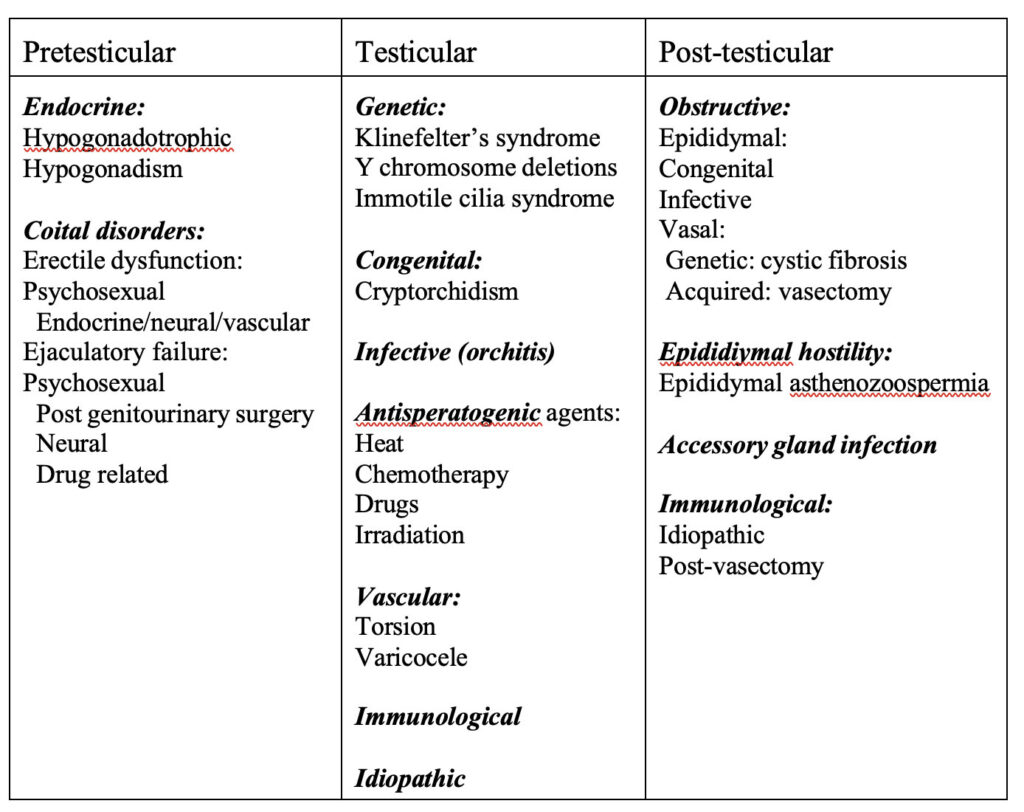
Table 4.5. Aetiological factors in male infertility. (From reference 61)
Although male infertility has received so much attention of late, female infertility is even higher than that of males. One couple in 10 seeks medical help because of infertility and a 1982-85 multicentre study by the World Health Organization found that in 20% of cases the problem was predominantly male, in 38% the problem was predominantly female, in 27% abnormalities were found in both partners and in the remaining 15% no clear-cut cause of infertility was identified.62 Although environmental pollutants and oestrogenic drugs may play a significant role in the decline in fertility, other factors, such as changes in diet, may be equally significant.
There have been significant changes in the consumption of animal products in Western societies over the last decades, and the consumption of dairy products in particular has increased dramatically. Fat consumption has also seen a significant increase in the past decades (see chapters 3 and 5) and these dietary changes have been associated with increased risk of degenerative diseases. Male prostate pathology has been linked to the consumption of dairy products,5 and this led us to investigate the possible link between the consumption of dairy products and reproductive health. The study was conducted on vervet monkey at the Primate Unit of the MRC in South Africa, so as to get as a close a model to the human as possible. Twelve monkeys were divided into two groups of six individuals each and they were put on diets containing 17% protein. The one group received largely maize and legumes and the other group milk powder as protein source. In order to assess the impact of high and low protein concentrations, after an initial two month period the protein allocation was
dropped to 8% from the respective sources and analyses were continued for an additional two month period. In this way the long- and short-term impact of the consumption of dairy products on reproductive health could be assessed. Already in the short-term, a significant decline in sperm quality, motility and concentration could be discerned, and these preliminary results were reported at the 6th International Congress on Cell Biology and 36th American Society for Cell Biology Annual Meeting held in San Francisco USA in 1996.63
When protein concentrations were high, the sperm concentrations between the two groups of monkeys were not significantly different, but progressive motility and the number of defective spermatozoa (particularly midpiece defects) increased. When protein concentrations were lowered to 8% crude protein, the group on dairy experienced a significant decline in sperm concentration, whilst the group on legume and maize showed no drop in sperm concentration and even showed an improved motility. Moreover, the number of defective spermatozoa also increased in the dairy group. In figures 4.10 and 4.11 the sperm progressive motility and the sperm concentration of the two groups of vervet monkeys is shown for the first four month period.
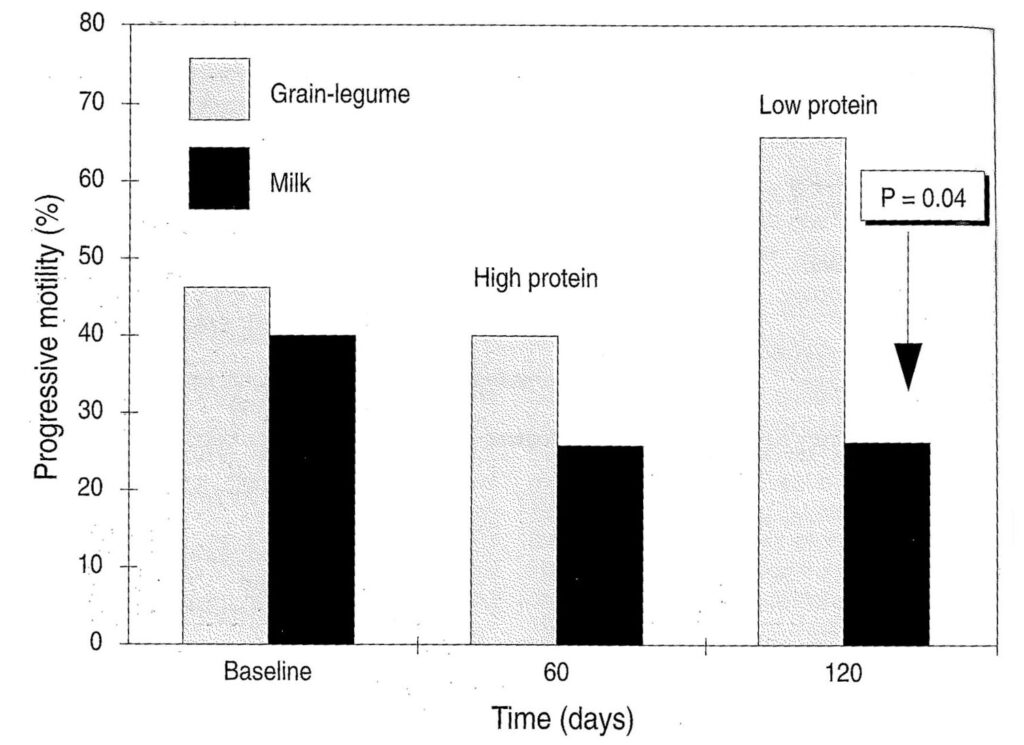
Figure 4.10. Progressively motile sperm of monkeys on milk and legume plus maize diets as protein source. (P=0.04 verified via the Wilcoxin 2-sample Test) The baseline represents the status of the animals at the start of the experiment before the introduction of the new dietary regime. (From reference 35).
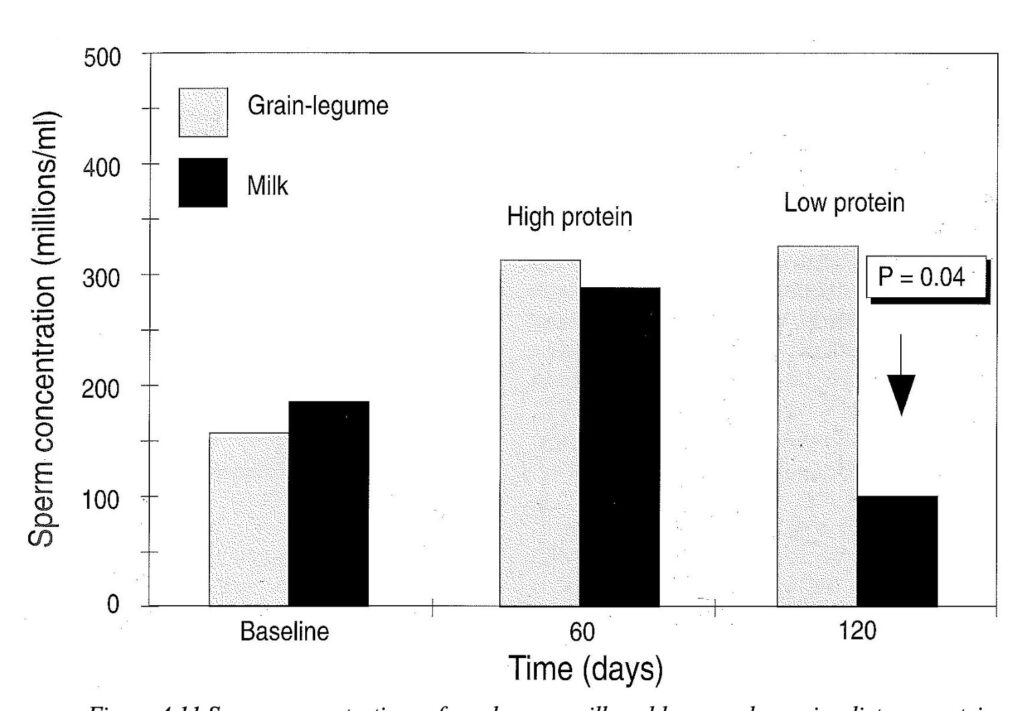
Figure 4.11 Sperm concentrations of monkeys on milk and legume plus maize diets as protein source. (P=0.04 verified via the Wilcoxin 2-sample Test) The baseline represents the status of the animals at the start of the experiment before the introduction of the new dietary regime. (From reference 35).