
Children have smaller stomachs than adults and they have higher needs for nutrients per unit weight, therefore diets that are appropriate for adults can indeed be deficient for young children. Children under three years can accommodate only 200-300ml food at each meal, and a high-fibre, low-calorie diet will put them at risk in view of their inability to consume sufficient quantities to meet their needs. Restrictive dietary regimes should again be avoided, and there must be a shift to more high-energy foods in order to sustain normal development. Again, variety is the watchword, and single-plant food diets, such as an exclusively fruitarian diet, would not supply sufficient nutrients for normal development.
Mother’s milk is the best food there is for infants. It is not advisable, if it can be helped, to substitute mother’s milk for the milk of other animals, as the composition of milk varies from species to species. Human infants are designed to drink human milk and a demand-type breast-feeding schedule would go a long way in meeting the infants’ needs, failing this, one should ensure that infants consume adequate quantities per meal as dictated by their age. The composition of mother’s milk will also vary with the mother’s diet, but it can be said that good wholesome food will make good wholesome milk. On the whole, the breast milk of vegetarians contains fewer environmental contaminants and additives than does the milk from omnivores,19 and it has been found that the vegetarian infant can thrive if care is taken to supplement iron, B-12 and vitamin D intake.
When the transition from breast-feeding to table foods is made, care must again be exercised not to follow restrictive diets as followed by some groups such as Zen macrobiotics, Black Hebrews and Rastafarians. These diets are normally schooled around a few grains, vegetables and fruits in addition to milk made from grains. They are often deficient in calories and proteins as well as numerous minerals and vitamins, particularly vitamins D and B-12. Such diets have led to numerous hospitalizations for malnutrition, and have been responsible for the deaths of a number of children.15,20,21
Some grains such as maize, increase up to six times in volume when cooked as a porridge, thus drastically reducing the energy content per unit-volume. Porridges in general will not supply sufficient energy for small children, and increased intake of cereals, nut butters, avocados, dried fruit spreads and legumes is recommended whilst limiting the amounts of fruits, vegetables and porridges (gruels).15,22,23 Nut butters such as almond, brazil, cashew, peanut, pecan and walnut butters or sesame-chick-pea butter, can be given to toddlers whilst avocado can also be served even to infants.22 Avocados are a rich source of numerous nutrients including fat, copper, potassium and riboflavin, and in view of their fat content they also supply more energy per unit mass than other fruits. Care must also be taken to choose combinations of grains and legumes or nuts and seeds to satisfy the amino acid requirements of vegan children. Furthermore, weaned children should receive vit. D and B-12 fortified soy milk or nut milk, particularly in areas where exposure to the sun is limited. Bearing these points in mind, it has been shown that vegan diets can support normal growth and development.24 In table 5.2 a diet plan for young vegan children is presented.

Table 5.2 Diet plan for young vegan children. (From reference 22).
The nutritive value of the diet plan for vegan children supplies sufficient nutrients to meet the demands of growing children, and can be substantially increased by more liberal servings. The nutritive value of the above diet plan is presented in figure 5.2.
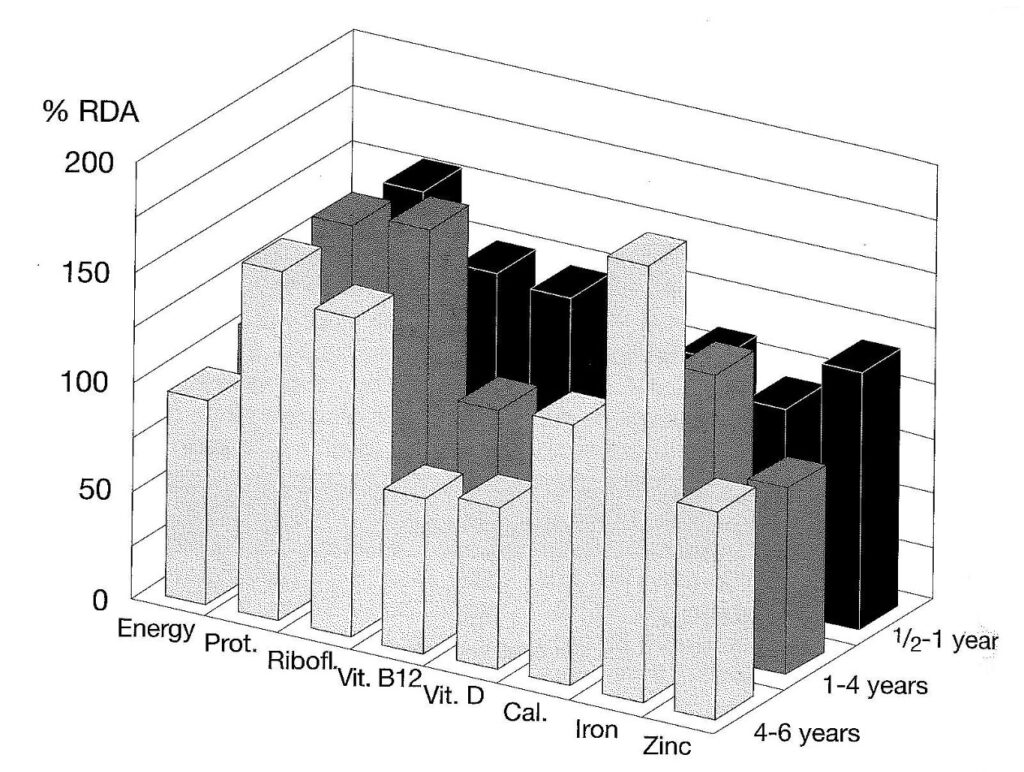
Figure. 5.2. Nutritive value of the basic diet plan for vegan children. Energy content can be increased with more liberal servings, B12 content can be improved by increased supplementation, vit. D by exposure to sunlight or supplementation and zinc content by the addition of wheat germ or supplementation. (From reference. 22)
As stomach capacity increases a gradual shift to adult eating patterns can take place. Preschoolers should still receive greater portions of energy-rich foods and foods high in Ca, Zn, Fe, plus supplementation of vitamin D and B-12.25 Furthermore, it is important to ensure a good mix of plant-protein sources. A whole-food diet, comprising legumes, grains, nuts, seeds, fruits and vegetables (inclusive of the leafy green varieties) together with fortified soy milk will have children brimming with health. If wholesome eating practices have been adopted in the family and care is taken to supply the special needs of younger children, then there is no need for concern. Furthermore, it is not necessary to cook separate meals for younger children, but merely to ensure that the relative portions that children obtain are geared to their needs.
Parents tend to enforce their own eating habits onto their children and might insist that the child eat more of the vegetables or fruits than of the nut-grain-legume dishes which the child needs for growth. Moreover, children also have a natural tendency to consume more of the energy-rich foods, and this should not be discouraged as long as it does not lead to the exclusion of the other essential foods. Healthful eating patterns should be established early, and if parents are concerned about the health and well being of their vegan children, then a “do as you please” attitude should not be adopted. However, having said this, it is also important that flexibility should be maintained and extremes avoided. Eating should be a pleasure, not a burden, and mealtimes should be something to look forward to. There should be a relaxed atmosphere at the table, conducive to good digestion, and children should not feel pressurized because parents hold very rigid, or fanatical views on nutrition.
A study done on British vegan children showed that the average energy intake was less than the recommended daily allowance for British children in general, particularly in the 2-4 year age group. But this is not uncommon, as many non-vegetarian children fail to meet the RDA. The average nutrient density, however, was higher for vegan diets for most nutrients, with the exception of calcium and fat, when compared to the average UK diet. The children tended to be lighter than the average, but normal in terms of their blood formation, educational and physical development. Vegan diets have received a bad press because of a few inappropriate diets, but appropriate vegan diets will rear healthy children. Moreover, there is no evidence that either intellectual function or physical stamina are adversely affected by a well-planned vegan diet.24