
Vegan diets in general are lower on calories than omnivorous diets, and as a result vegans are normally slimmer than their omnivorous counterparts. It was found that vegetarians weigh some 8kg less than meat eaters who in turn are, on average, 5-7 kg overweight.3 The lower weight of vegetarians has distinct health advantages in that slim people fall into lower risk categories regarding cardiovascular diseases and cancer.8,9 Obviously the body requires a minimum intake of energy to stay alive, and the number of calories required varies with sex, size and body weight. Adults require some 1 000-1 700 calories per day at rest (basal metabolic rate or BMR) whilst activity increases the energy expenditure. The average energy consumed per day is 2 000 calories for women and 2 700 for men, whereas heavy manual labour or sporting activity can increase the requirements to as much as 4 000 calories per day. The vegan diet has a lower fat and protein content and a higher carbohydrate content than most other diets, and particular attention must be paid to energy intake as the energy supply from fat is some 9,4 kcal/g, whereas carbohydrates and proteins supply only 4,2 and 4,3 kcal/g respectively.
Vegetarian dietary patterns for adults
Food guides in general are useful in teaching, but the average person will not pay much heed to them unless he can be educated to do so. The vegetarian tribes of the world also do extremely well without the use of dietary charts and lists of recommended daily allowances (RDA). The diets that have been established in these tribes have, however, arisen over time and have been practised for generations, whereas Western societies must rediscover simple wholesome eating practices. Moreover, there are so many so-called health foods and metaphysically inspired health notions, that the health-food industry has become a veritable minefield of misinformation. Under these circumstances it is prudent to make a thorough investigation of the issue, and not to avoid the voice of science.
In general the Western societies adhere to the Basic-Four nutritional guide which correlates adequate nutrition with regular intake of the four basic food types: Dairy products, breads and cereals, fruits and vegetables and meat. It is interesting that even this Basic-Four Food Guide was found to be lacking in vitamin E, vitamin B-6, magnesium, zinc and iron.10 In the past, these four food groups were depicted as of equal importance, and the plate was divided into four quarters each with one of these food groups. This Basic-Four diet has recently come under attack from health circles, but intensive lobbying by the meat and dairy industry have managed to keep it at least partially afloat in the minds of the general public. In the past American school children were taught that a healthy diet included meat every day, but now the US government has recognised that a vegetarian diet can be healthy. In 1992 the USDA issued a revised recommendation in which the “food pyramid” was used for the first time. It was now suggested that grains and cereals form the bulk of the diet, vegetables and fruits were suggested as next in importance followed by animal product and finally fats, oils and sugars which were to be used sparingly. The 1996 guidelines are a further advance on this, and the
inclusion of vegetarianism as a healthy alternative may almost be considered bold. The 1996 guidelines state “ Most vegetarians eat dairy products and eggs and, as a group, these lacto-ovo-vegetarians enjoy excellent health”. The guidelines, however still warn against a strict vegan diet and supplementation of iron, zinc, and B-vitamins is suggested.11 The change of heart comes from an overwhelming body of evidence that the consumption of animal products is a health risk, and it can be expected that more changes in lifestyle will be recommended in the future. Already, Michael Jacobson, executive director of the “Centre for Science in the Public Interest” criticized the US government for not coming out more strongly against meat in the 1996 guidelines.11 Vegan vegetarians need different guidelines to those commonly accepted in Western societies, and they need to plan their eating regimes carefully, nevertheless a balanced vegan lifestyle is not only possible, but can indeed be desirable in terms of health.
Ovo-lacto- and lacto-vegetarians have less of a problem in meeting caloric needs than do vegan vegetarians, and that is why the safety of lacto-ovo-vegetarian eating patterns is normally emphasized in dietetic recommendations, whilst specialized dietary planning is recommended for vegan type diets.6,12 The energy component of ovo-lacto-vegetarian diets is boosted by the animal fats included in these diets and are therefore not to be regarded as a positive aspect of these diets. Vegan vegetarians must plan diets that will compensate for the omission of dairy products, by ensuring that they include adequate quantities of high energy foods in their diets, which must also meet all the other basic needs of the body. Provided this is done, it has been shown that a vegan diet can provide all the body’s needs and can be followed without fear. A number of suggested vegan diet patterns have been analysed, and it was found that the diet suggested by Selma Chaij-Rhys came closest to satisfying daily nutritional needs of adults.7,16 In addition this diet uses a simple numerical formula and starts off by using grains, fruits, nuts and vegetables, and adds vegetable-protein foods fortified with vitamin B-12, such as fortified soy milk or simply a B-12 supplement. The numerical formula used in this diet guide is the 1-2-3-4-5 pattern, to help the user remember the number of servings to be used in each food category per day (Table 5.1).

Table 5.1. Chaij-Rhys diet plan for adult vegans. (From ref. 6 and 13)
This eating pattern will supply more than double the RDA of iron, particularly as the high vitamin C content will enhance the utilization and absorption of non-haem iron.14 Riboflavin and niacin needs are also met. The pattern, however, falls short in protein and energy, particularly in men, but the use of a larger serving size would help to bridge the energy gap. In women the Chaij-Rhys diet plan will supply adequate nutrition in all the nutrients with the exception of calories. Again a somewhat larger serving will cater for all the needs, including energy needs.
To satisfy protein needs, correct food combinations are essential, as various plant-protein sources complement one another. This issue will be discussed more fully in chapter 7, but an example can be given here to illustrate the point. Legumes are high in lysine but low in the sulphur-containing amino acids methionine and cystine, and the combination of legumes with grains, which are high in methionine and threonine and low in lysine, will provide an excellent protein.15 To achieve a proper amino-acid balance is thus not nearly as complicated as it sounds, and the ordinary peanut butter sandwich will supply complete proteins as it is a combination of a grain (wheat) and a legume (peanuts).
Dietary patterns for pregnant and lactating mothers
Vegetarian women are on the whole more health-conscious than non-vegetarians and will tend to adjust their diets to meet the demands of pregnancy or lactation. Pregnant women have greater energy needs, but the relative increase in energy needs is small compared to the greater need for certain vitamins and minerals (Fig. 5.1).

Figure 5.1. Percent increase in dietary needs during pregnancy. (From reference 15)
This data suggests that the choice of energy-rich foods during pregnancy must also include adequate concentrations of vitamins and minerals. Nutrients that need particular attention during this period are vitamins D and B-12, calcium, iron and zinc. Fortified soy milk is a good way of obtaining these nutrients, particularly B-12, as deficiencies of this vitamin have been reported in cases of breast-fed infants whose mothers were vegans.17
Dietary patterns that supply satisfactory quantities of nutrients for pregnant women are the Seventh-day Adventist Dietetic Association plan for pregnant women.6 This plan requires four protein servings of nuts, seeds or legumes, four soy milk servings, six grain or cereal servings, and eight servings of vegetables or fruits per day.18 The Chaij-Rhys plan does not supply sufficient nutrients to cater for the increased demands of pregnancy, even if an additional serving is added in each category of food,6 but if more fortified soy milk is added in addition to the increased number of servings, then nutrient levels should satisfy the additional demands experienced during pregnancy or lactation. In countries where fortified soy products such as soy milk are not readily available it is advisable to take supplements or to add vitamin D and B-12 to home-made soy milk.
Finally it is strongly recommended that one minimizes the use of empty-calorie foods such as refined foods, and concentrate on whole foods. Additionally, it goes without saying that substances and foods that are detrimental to health, such as alcohol, tea and coffee, should be avoided at all costs during pregnancy.
Dietary patterns for infants and young children
Children have smaller stomachs than adults and they have higher needs for nutrients per unit weight, therefore diets that are appropriate for adults can indeed be deficient for young children. Children under three years can accommodate only 200-300ml food at each meal, and a high-fibre, low-calorie diet will put them at risk in view of their inability to consume sufficient quantities to meet their needs. Restrictive dietary regimes should again be avoided, and there must be a shift to more high-energy foods in order to sustain normal development. Again, variety is the watchword, and single-plant food diets, such as an exclusively fruitarian diet, would not supply sufficient nutrients for normal development.
Mother’s milk is the best food there is for infants. It is not advisable, if it can be helped, to substitute mother’s milk for the milk of other animals, as the composition of milk varies from species to species. Human infants are designed to drink human milk and a demand-type breast-feeding schedule would go a long way in meeting the infants’ needs, failing this, one should ensure that infants consume adequate quantities per meal as dictated by their age. The composition of mother’s milk will also vary with the mother’s diet, but it can be said that good wholesome food will make good wholesome milk. On the whole, the breast milk of vegetarians contains fewer environmental contaminants and additives than does the milk from omnivores,19 and it has been found that the vegetarian infant can thrive if care is taken to supplement iron, B-12 and vitamin D intake.
When the transition from breast-feeding to table foods is made, care must again be exercised not to follow restrictive diets as followed by some groups such as Zen macrobiotics, Black Hebrews and Rastafarians. These diets are normally schooled around a few grains, vegetables and fruits in addition to milk made from grains. They are often deficient in calories and proteins as well as numerous minerals and vitamins, particularly vitamins D and B-12. Such diets have led to numerous hospitalizations for malnutrition, and have been responsible for the deaths of a number of children.15,20,21
Some grains such as maize, increase up to six times in volume when cooked as a porridge, thus drastically reducing the energy content per unit-volume. Porridges in general will not supply sufficient energy for small children, and increased intake of cereals, nut butters, avocados, dried fruit spreads and legumes is recommended whilst limiting the amounts of fruits, vegetables and porridges (gruels).15,22,23 Nut butters such as almond, brazil, cashew, peanut, pecan and walnut butters or sesame-chick-pea butter, can be given to toddlers whilst avocado can also be served even to infants.22 Avocados are a rich source of numerous nutrients including fat, copper, potassium and riboflavin, and in view of their fat content they also supply more energy per unit mass than other fruits. Care must also be taken to choose combinations of grains and legumes or nuts and seeds to satisfy the amino acid requirements of vegan children. Furthermore, weaned children should receive vit. D and B-12 fortified soy milk or nut milk, particularly in areas where exposure to the sun is limited. Bearing these points in mind, it has been shown that vegan diets can support normal growth and development.24 In table 5.2 a diet plan for young vegan children is presented.

Table 5.2 Diet plan for young vegan children. (From reference 22).
The nutritive value of the diet plan for vegan children supplies sufficient nutrients to meet the demands of growing children, and can be substantially increased by more liberal servings. The nutritive value of the above diet plan is presented in figure 5.2.
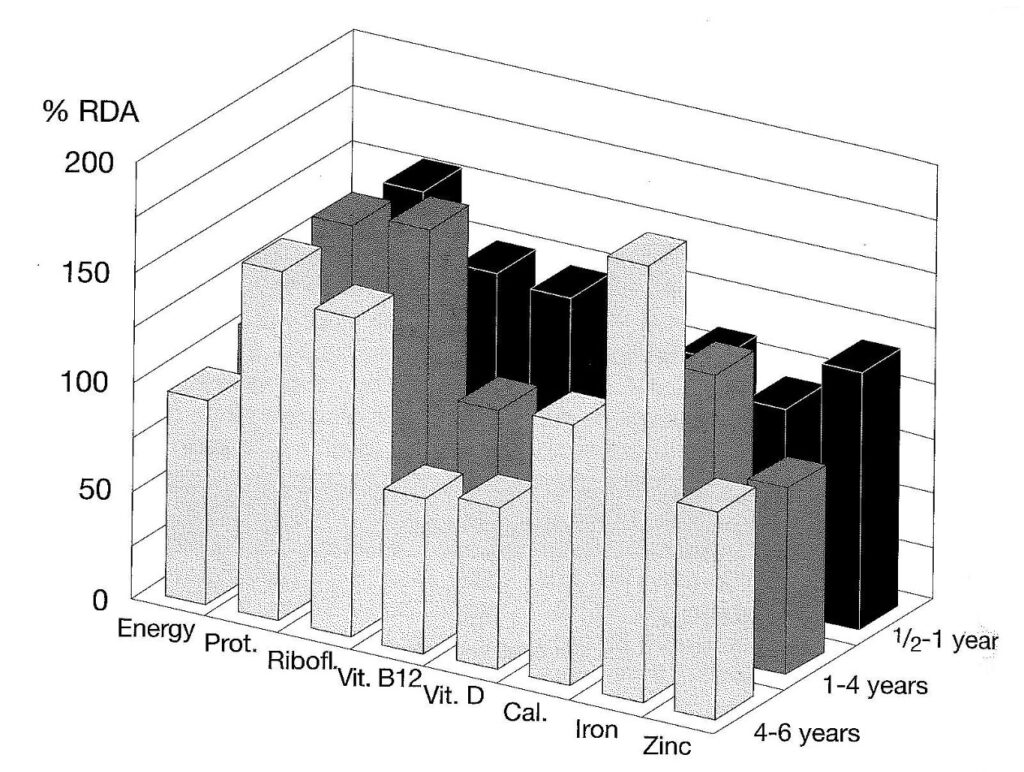
Figure. 5.2. Nutritive value of the basic diet plan for vegan children. Energy content can be increased with more liberal servings, B12 content can be improved by increased supplementation, vit. D by exposure to sunlight or supplementation and zinc content by the addition of wheat germ or supplementation. (From reference. 22)
As stomach capacity increases a gradual shift to adult eating patterns can take place. Preschoolers should still receive greater portions of energy-rich foods and foods high in Ca, Zn, Fe, plus supplementation of vitamin D and B-12.25 Furthermore, it is important to ensure a good mix of plant-protein sources. A whole-food diet, comprising legumes, grains, nuts, seeds, fruits and vegetables (inclusive of the leafy green varieties) together with fortified soy milk will have children brimming with health. If wholesome eating practices have been adopted in the family and care is taken to supply the special needs of younger children, then there is no need for concern. Furthermore, it is not necessary to cook separate meals for younger children, but merely to ensure that the relative portions that children obtain are geared to their needs.
Parents tend to enforce their own eating habits onto their children and might insist that the child eat more of the vegetables or fruits than of the nut-grain-legume dishes which the child needs for growth. Moreover, children also have a natural tendency to consume more of the energy-rich foods, and this should not be discouraged as long as it does not lead to the exclusion of the other essential foods. Healthful eating patterns should be established early, and if parents are concerned about the health and well being of their vegan children, then a “do as you please” attitude should not be adopted. However, having said this, it is also important that flexibility should be maintained and extremes avoided. Eating should be a pleasure, not a burden, and mealtimes should be something to look forward to. There should be a relaxed atmosphere at the table, conducive to good digestion, and children should not feel pressurized because parents hold very rigid, or fanatical views on nutrition.
A study done on British vegan children showed that the average energy intake was less than the recommended daily allowance for British children in general, particularly in the 2-4 year age group. But this is not uncommon, as many non-vegetarian children fail to meet the RDA. The average nutrient density, however, was higher for vegan diets for most nutrients, with the exception of calcium and fat, when compared to the average UK diet. The children tended to be lighter than the average, but normal in terms of their blood formation, educational and physical development. Vegan diets have received a bad press because of a few inappropriate diets, but appropriate vegan diets will rear healthy children. Moreover, there is no evidence that either intellectual function or physical stamina are adversely affected by a well-planned vegan diet.24
Adolescents and young adults
Adolescents have greater needs for energy, protein, Ca, P, Fe, Zn and vitamin A because of the rapid growth during this stage.15 Besides catering for the higher protein and energy needs, care should be taken that the diet includes green leafy vegetables or other foods rich in calcium. Supplementation to augment supplies of B-12 and zinc are also recommended for this stage.
Energy requirements
Energy requirements depend largely on lifestyle, but tend to vary between 1 800 calories per day for a sedentary to mildly active individual to in excess of 3 500 calories per day for intensely active individuals. Vegan vegetarians need to consume a greater proportion of high energy foods such as grains, legumes, seeds, nuts and energy rich fruits and vegetables than do non-vegans. Non-vegan vegetarians tend to have a higher fat intake than vegans, because of the consumption of dairy product and eggs, and this makes it easier for them to meet their energy demands. The consumption of these animal fats and proteins, however puts them in a higher risk category in terms of degenerative diseases. Normally, the natural cravings of the system will ensure that sufficient energy-rich foods are consumed, particularly by active people, but when there are changes in lifestyle it may be useful to calculate what the body’s needs are in order to put one’s mind at rest.
To calculate the daily number of calories required for one’s particular lifestyle, it is necessary to know what one’s BMR (Basal Metabolic Rate) is, and the multiple of BMR associated with a particular lifestyle. The BMR is the energy expended while lying awake but completely still and the multiple of BMR is the factor by which BMR must be multiplied in order to account for other daily activities such as walking etc. The “Dunn Clinical Nutrition Centre” in Cambridge UK, recently collated measurements from all over the world in order to estimate the multiple of BMR associated with various activities. These are summarised in table 5.3., and the formulas for calculating the BMR are presented in table 5.4.

Table 5.3. The multiple of BMR associated with various activities.( From reference 26)

Table 5.4. Equations for calculating BMR. (From reference 26)
Using the data above, it is now possible to calculate the total energy needs per day. First calculate the BMR using the formulae in table 5.5 and multiply it by the appropriate “multiple of BMR” from table 5.4.
Example:
A housewife aged 35 and weighing 55 kilograms
BMR = (8.3 x 55) + 846 = 1302
Multiple of BMR for a housewife = 1.8
Total calories required = 1302 x 1.8 = 2345
To convert to kilojoules, multiply this figure by 4.2
HEALTH ASPECTS OF THE VEGETARIAN DIET
Vegetarians have a lower incidence of degenerative diseases than do non-vegetarians, and as the foundations for many of these diseases are already laid in childhood,27 it is prudent to establish good eating habits early on in life.
The vegetarian lifestyle has often been met with suspicion, if not outright scorn, but in recent times the positive effects of a vegetarian lifestyle have come to be recognized. More research has been done on vegetarianism in the past two decades than in the entire history of the human race, and thorough reviews of the relevant literature exist.28 Of all the vegetarian groups studied, the World Health Organization made special mention of the Seventh-day Adventists as they, on different occasions have received special notice because of their low number of heart attacks, cancer and other diseases related to lifestyle.29 Seventh-day Adventists generally, though not exclusively, follow a vegetarian lifestyle, with all types of vegetarianism represented. They also avoid alcohol and smoking, which makes them an ideal study group and probably accounts for the fact that mortality rates for lung cancer are only 20% of those of the general populace, whereas the low figures for throat cancer (5%), bladder cancer (28%) and cirrhosis of the liver (13%) are probably also as a consequence of the avoidance of these commodities. Mortality is also down for most other diseases, and with the exception of breast cancer (72%), digestive tract cancer (65%), ovarian cancer (61%) and heart attacks and angina
(55%), the mortality for most other diseases is less than 50% of that of the general populace.5,28,30,31,32,33,34,35,36
In view of the strong correlation between the consumption of dairy products and eggs with some of the types of cancers listed above, it is not surprising, that those who’s lifestyles where more vegetarian, or tended towards the vegan lifestyle, had lower age specific mortality rates than those whose lifestyles tended towards omnivorous diets.37 Numerous studies, on vegetarianism in general, have shown that it is not only the longevity of life that is extended in vegetarians, but that the quality of life is also improved. This is because many of the common diseases that plague mankind are less prevalent among vegetarians than among their omnivorous counterparts.